Comprehensive 
Mental Health Solutions

For School Districts

From Reactive Support to Proactive Care
Address mental health before it becomes a crisis. Our integrated platform identifies students who need support early, connects them to caring professionals, and tracks their progress with data that shows your positive impact.
Group of diverse young students smiling and standing together, representing proactive mental health support in schools.

MTSS / SEL

MTSS, PBIS, SEL daily, staff wellness, data reviews.

Reactive Referrals

Internal referrals, behavior incidents, absenteeism, 1:1 follow-up.

MIYO Capabilities

Early Intervention

Universal screening, 1:1 counseling, consent, triage, SIS integration, dashboards.

Easy Access to Therapy

Internal counselors, social workers, external referrals, community partners, teletherapy.

Outcome Measurement

Centralized system, FERPA/HIPAA, progress tracking, dashboards.

Easy Access to Therapy

Internal counselors, social workers, external referrals, community partners, teletherapy.

Sustainable MH Program

We offer a comprehensive MH package and fill your unique gaps

Even though we offer a comprehensive mental health package, we collaborate with our district partners to fill the gaps
Readiness
Early Intervention
Access to Therapy
Outcome Measurement
Funding

Districts seeking to establish a baseline understanding of current mental health operations, policies, and readiness levels.

  • Need for defined protocols for parental consent and notification procedures.
  • Uncertainty regarding current mental health budget allocation and efficiency.
  • Lack of clearly established staff responsibilities for screening and follow-up.
  • Need for a centralized repository for policy documentation and operational plans.
  • Opportunity to build staff confidence in managing student mental health needs.

Districts currently screening but failing to identify internalizing issues or manage case data effectively.

  • Over-reliance on behavioral screening, which misses silent or internalized risks.
  • Student data is fragmented across various systems, making comprehensive case view difficult.
  • Absence of an automated system for linking screening results to intervention tiers.
  • Delays in communication between identifying a need and notifying parents/intervention staff.
  • Need to integrate evidence-based, clinical screeners (e.g., PHQ-9) into the workflow.

Identified students face obstacles accessing in-person or teletherapy due to resource or location challenges.

  • Significant staff vacancies among school-based mental health professionals.
  • Geographical barriers in rural areas limiting access to specialized private practices.
  • Student waiting lists are extensive for community-based mental health services.
  • Need for increased capacity to provide culturally and linguistically diverse therapists.
  • Requirement for a secure, HIPAA/FERPA compliant method for delivering remote therapy.

Therapy is delivered, but districts lack tools to quantify efficacy and demonstrate student improvement.

  • Absence of a standardized method to track student symptom reduction post-intervention.
  • Inability to correlate mental health interventions with key academic indicators (GPA, attendance).
  • Challenges in generating required reports for state and federal accountability standards.
  • Need for transparent data visualization to communicate program impact to stakeholders.
  • Treatment modification relies primarily on individual observation rather than empirical outcome data.

Districts need robust data to justify current fund utilization (e.g., Medicaid, ESSER) and secure future grant funding.

  • Difficulty in tracking services provided for maximizing Medicaid reimbursement potential.
  • Need for metrics that clearly demonstrate the success of ESSER-funded mental health initiatives.
  • Inconsistent documentation processes hindering full federal funding compliance.
  • Requirement to quantify the cost-benefit relationship of prevention programs, such as reduced dropout rates.
  • Lack of formal systems for documenting the return on investment (ROI) of mental health efforts.

Key Differentiators

PD Resource Library

Evaluate and support student behavior, learning, and mental health

Provider Network

Provide emotional support and coping strategies to improve student mental well-being.

Industry Experts

Connect students with resources to address emotional, social, and behavioral needs.

HIPAA/FERPA

Offer therapy services to address students' emotional and mental challenges

Advanced Platform

Provide clinical care for complex emotional and behavioral student needs

Platform Capabilities

Complete data integration with over 95 SIS/LMS systems
Platform includes 35+ pre-programmed mental-health screeners and assessments
Multilingual support (English, Spanish)
Group or 1:1 e-consents capability
Several treatment plans, including Wiley Treatment Plan
Embedded teletherapy with flexible documentation templates
Medicaid billing reports in 835/837 format
Advanced analytics overlaying mental-health progress against grades, absenteeism, incident reports, etc.
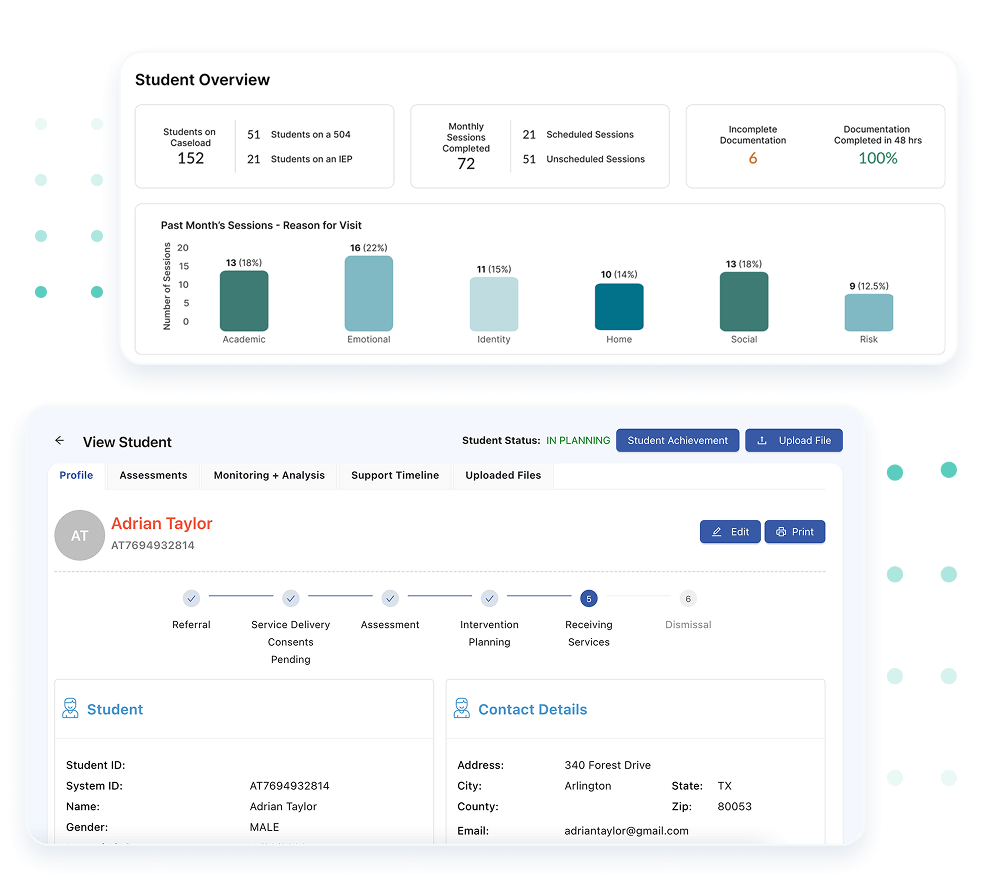
Student dashboard displaying caseload overview, session tracking, and reason-for-visit charts, alongside platform features like clinical workflows, Medicaid optimization, and outcome reporting.

Common Hurdles Faced by 

Districts & How MIYO Helps

Provider shortage

MIYO connects districts to a network of licensed providers and supports hybrid models with teletherapy.                                                  

We have no expertise in mental health, where do we begin?

MIYO provides structured pathways, guided workflows, and evidence-based practices that help districts confidently support student mental health, even without an in-house specialist team.

How is mental health different from SEL?

SEL builds skills for all students to thrive socially and emotionally.
Mental health support focuses on identifying needs, assessing risk, and providing tiered intervention.
MIYO bridges both worlds by giving clarity, screening tools, and decision support.

Why do we need universal screening?

Screening uncovers students who may otherwise go unnoticed.
With MIYO, screening is automated, bilingual, consent-linked, and integrated into referral workflows, enabling early support instead of reactive crisis management.

Our intake and referral processes are manual. Can MIYO help?

Yes. MIYO automates the entire workflow from intake to risk scoring, assignment and follow-up ensuring cases move forward smoothly without email chains, paper tracking, or lost information.

Can we use our own consent forms?

Absolutely. District-approved consent templates can be uploaded and used digitally with secure e-signature tracking inside MIYO.

Can we use our own custom intake forms?

Yes. MIYO includes a flexible form builder that allows districts to create custom intake formats, add conditional logic, and route forms automatically to the right team members.

Our school counselors spend 2 hours manually pulling data from 5+ systems to 
prepare for a parent meeting, can MIYO help?

MIYO centralizes everything student history, screenings, notes, consents, referrals, interventions, communication, into a single student file accessible in seconds.

We know we need more resources and a better platform, where do we find funding?

With MIYO, districts generate measurable data (needs, caseloads, outcomes) that strengthens funding proposals, supporting grant applications and state-aligned funding pathways.


Ready to Transform 
Student Outcomes?